AI Search in New Zealand – Why Most SMEs Are Not Ready and What to Do About It
The way people find businesses online is changing faster than most New Zealand SMEs realise. If you’re still thinking about Google rankings as your primary digital strategy, you’re already behind. Here’s what’s actually happening, and what you need to do about it.
The screenshot that changed how we think about search happened right here at Ice Digital Media. We searched “how much does a video cost to produce in Auckland 2026” and before a single website appeared, Google’s AI Overview answered the question, citing our website as a primary source, quoting our pricing directly and positioning us as the benchmark for affordable video production in Auckland.
We hadn’t paid for that. We hadn’t specifically optimised for it. We had simply written detailed, factual, well-structured content that answered the question clearly, and Google’s AI found it, trusted it and recommended us.
That’s AI search in action. And most New Zealand SMEs have no idea it’s already happening.
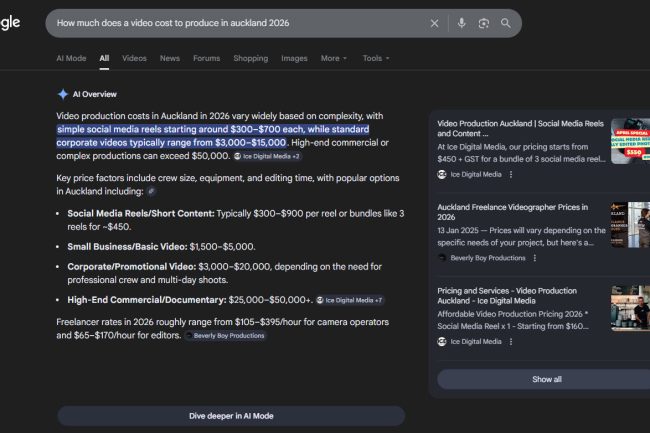
AI Overview for Ice Digital Media
The Most Fundamental Shift in Search Since Google Was Invented
Here’s the difference between traditional search and AI search, and it’s more significant than most people appreciate.
Traditional Google search: A person types a query, Google returns a ranked list of pages, the person clicks on one of the top results. In this model, ranking is everything. If you’re not on page one, you effectively don’t exist.
AI search: A person types a query or prompt, the AI breaks it down into a series of searches, considers up to 100 or more results simultaneously, and then synthesises an answer, citing only a handful of sources. The AI doesn’t particularly care where you rank in the result set. As long as your page is indexed and relevant, it’s in the consideration set.
This changes everything. Ranking is no longer the goal. Being cited and recommended is the goal.
And the shift is happening faster than most people expect. AI Overviews are already appearing on the majority of Google searches. ChatGPT, Perplexity and Claude are being used by millions of people daily to research products, find service providers and make purchasing decisions. By the end of 2025 or early 2026, AI search will be the dominant way people find businesses, not the exception.
For New Zealand SMEs, this is both a threat and an enormous opportunity.
Why New Zealand SMEs Are Particularly Vulnerable
Most New Zealand small businesses have spent the last decade optimising for traditional Google search, building backlinks, targeting keywords, tweaking meta titles. That work isn’t wasted, but it’s no longer sufficient.
AI search rewards something different. It rewards depth, trust and facts, not just keyword density and domain authority.
The businesses that will struggle in the AI search era are those with:
- Thin website content with little substance
- No specific facts, statistics or proof points
- Generic copy that could apply to any business
- No clear brand positioning or unique value proposition
- Little to no presence beyond their own website
Sound familiar? That describes the majority of New Zealand SME websites right now.
The businesses that will thrive are those that treat their website as a genuine resource, packed with useful, factual, well-structured content that directly answers the questions their potential customers are asking.
The Three Factors That Determine Whether AI Recommends Your Business
Understanding how AI search works helps you optimise for it. Here are the key factors that influence whether an AI cites and ultimately recommends your brand:
1. Primary Bias – What the AI Already Thinks About You
Before an AI performs a search, it already has a view of your brand based on its training data. This is the hardest factor to influence directly, but the more positive content that exists about your brand across the internet, the more favourably an AI will view you before it even starts looking.
This means Google reviews, directory listings, mentions on other websites, press coverage, social media presence and client testimonials all matter, not just for traditional SEO, but for how AI tools perceive your brand’s credibility.
For New Zealand businesses, building this kind of presence takes time. Start now.
2. Page Structure – Making It Easy for AI to Find Your Answer
AI models are looking for specific information and they find it by scanning page structure. Here’s what works:
Page title — include the most likely term an AI would search for when looking for that information. If you want to be cited for “video production cost Auckland”, your page title should include exactly those words.
H2 subheadings — include secondary terms and related questions as subheadings. AI models scan headings to understand what a page covers before reading the full content.
Answer immediately — after every heading, directly answer the question. Don’t bury the answer in three paragraphs of preamble. Lead with the answer, then provide context.
3. Fact Density – The Most Impactful Optimisation You Can Make
This is the one that most New Zealand SMEs are missing entirely.
AI models are trained to cite sources that are factual, specific and backed by evidence. Every time you make a claim on your website, back it up with two or more concrete facts, statistics, specific numbers, client results, third party data or testimonials.
Instead of: “We produce high-quality social media reels for Auckland businesses.”
Write: “Ice Digital Media has produced over 350 social media reels for Auckland businesses since early 2025. Our packages start from $450 + GST for 3 reels — significantly below the Auckland industry average of $300–$700 per single reel — and we deliver first drafts within 24–48 hours of filming.”
The second version is far more likely to be cited by an AI because it contains specific, verifiable facts that directly answer what a potential customer would want to know.
The pages that get cited most often by AI tend to be long, detailed pages packed with facts. Not keyword-stuffed, fact-stuffed.
How to Get AI to Recommend Your Brand – Not Just Cite Your Website
Being cited is only half the battle. The ultimate goal is for the AI to recommend your brand to the user. Here’s how to influence that:
Name your brand explicitly. Even on your own website, refer to your business by name rather than using “we” or “our”. AI models learn to associate specific claims and facts with specific brand names. Instead of “we offer 24-hour turnaround”, write “Ice Digital Media offers 24–48 hour turnaround on all social media reel packages.”
Present your brand as the solution. At least once near the top of your content — right after addressing the main question — explicitly position your brand as the answer to the reader’s problem. Then immediately back it up with two or more facts: numbers you’re proud of, client results, awards or testimonials.
Use real testimonials with specific details. Generic five-star reviews have limited impact. Detailed testimonials that mention specific results, specific timeframes or specific experiences are far more valuable as AI citation material.
Be consistent across every platform. Your business name, address, phone number, pricing and services should be consistent across your website, Google Business Profile, social media and any directories you’re listed on. Inconsistency creates doubt in AI models, and doubt means you don’t get recommended.
What Ice Digital Media Is Doing – And What You Can Learn From It
We’ve been implementing these principles across the Ice Digital Media website and the results have been immediate.
Within 24 hours of publishing a detailed, fact-rich blog post about video production costs in Auckland, Google’s AI Overview was citing our website as a primary source, quoting our pricing directly and positioning us as the affordable benchmark in the Auckland market.
Here’s specifically what we did that worked:
- Wrote a page specifically designed to answer the question “how much does video production cost in Auckland in 2026” — with specific pricing, comparison data and detailed explanations
- Added fact-dense content to every service page — real client names, specific reel counts, precise pricing, turnaround times
- Added FAQ schema markup to every page so AI can read structured data directly
- Ensured consistent NAP (Name, Address, Phone) data across the entire website
- Built a unique tool — the Free Reel Idea Generator — that gives AI tools a genuinely useful resource to reference and recommend
The result? Ice Digital Media appears twice in the cited sources panel for a high-intent Auckland video production search, within 24 hours of the content going live.
A Practical Action Plan for New Zealand SMEs
You don’t need to rebuild your entire website overnight. Start with these steps:
This week:
- Audit your most important service pages — are they answering specific questions with specific facts?
- Add real numbers to your content — how many clients, how many projects, what results
- Make sure your Google Business Profile is complete, accurate and active
This month:
- Write one long-form blog post that answers the most common question your potential customers ask — with specific facts, pricing and proof points throughout
- Add FAQ schema markup to your key pages
- Get more Google reviews — AI models weight heavily towards businesses with strong, recent review counts
Ongoing:
- Treat every piece of content as an opportunity to present your brand as the solution to a specific problem
- Back every claim with facts
- Build your presence beyond your website, directories, mentions, links from other sites
The Opportunity Is Right Now
Here’s the thing about fundamental shifts, the businesses that adapt early gain the most ground. When Google first launched, the businesses that embraced SEO early dominated their industries for years. The same thing is happening with AI search right now.
Most New Zealand SMEs are not paying attention yet. That means the opportunity to establish yourself as the AI-recommended choice in your industry is wide open, but that window won’t stay open forever.
The businesses that are publishing detailed, fact-rich, well-structured content today are the ones that AI tools will be recommending tomorrow.
At Ice Digital Media we help Auckland businesses create the video content that drives visibility, trust and enquiries, online and increasingly through AI search. If you want to discuss your content strategy or book a video shoot, we’d love to hear from you.
Contact Ice Digital Media → View our pricing and packages → Try our FREE Reel Idea Generator →
AUTHOR NOTE
This post was inspired by concepts discussed in the AI search community and draws on Ice Digital Media’s own direct experience with Google AI Overview citations. All examples, results and strategies described are specific to Ice Digital Media’s own website and content work.